Koch Research Fellows Ed Younkins, Jomana Krupinski, and Kaitlyn Pytlak have shared with me the results of a survey they conducted of 250 Business and Economics professors and 250 English and Literature professors. They asked these two groups of professors to rank the best novels and plays about business. The top 25 from each group are listed separately in the table below. What makes the results particularly interesting is that 15 titles appear on both lists, indicating a surprising level of agreement between the two groups of professors. But the two groups did not rank the 15 the same and each selected 10 other books the other group did not, so there was significant disagreement as well.
Atlas Shrugged
Help Promote Prometheus Unbound by Sharing this Post

THE LIBERTARIAN TRADITION PODCAST | Ayn Rand and the Early Libertarian Movement
in “Literary” Fiction, Featured Posts, Novels, Science Fiction, The Libertarian Tradition Podcast
PODCAST: Play in New Window | Download (Duration: 20:30 — 7.2MB) | Embed

In this January 12, 2010 episode of the Libertarian Tradition podcast series, part of the Mises Institute’s online media library, Jeff Riggenbach discusses the important role played by novelist and philosopher Ayn Rand in the early libertarian movement.
Editor’s Note: A transcript is unavailable. This early episode was never turned into a Mises Daily article most of the others.
Here is a brief summary, however:
In light of then recently released books on Ayn Rand — Jennifer Burns’s Goddess of the Market: Ayn Rand and the American Right and Anne C. Heller’s Ayn Rand and the World She Made — Riggenbach discusses Rand’s role in the early libertarian movement. Along the way he highlights Heller’s defense of the quality of Rand’s writing against mainstream literary critics. He goes on to argue that Heller’s book is the better of the two and explains what mars Burns’s book. He plays a couple of clips of Rand herself explaining why she and her philosophy of Objectivism are not conservative, and challenges the coherence of Burns’s conception of the American Right.
If you’re unfamiliar with Ayn Rand and her importance in the libertarian tradition, this episode offers a good primer on the subject as well as on what differentiates libertarianism and conservatism.
Help Promote Prometheus Unbound by Sharing this Post

THE LIBERTARIAN TRADITION PODCAST | A History of Ayn Rand
in “Literary” Fiction, Featured Posts, Novels, Science Fiction, The Libertarian Tradition Podcast
PODCAST: Play in New Window | Download (Duration: 19:35 — 6.8MB) | Embed
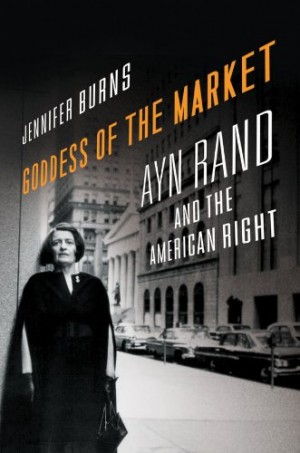
In this January 6, 2010 episode of the Libertarian Tradition podcast series, part of the Mises Institute’s online media library, Jeff Riggenbach takes us on a biographical tour of the life of libertarian novelist and philosopher Ayn Rand.
Editor’s Note: A transcript is unavailable. This early episode was never turned into a Mises Daily article like most of the others.
Here is a brief summary, however:
In light of then recently released books on Ayn Rand — Jennifer Burns’s Goddess of the Market: Ayn Rand and the American Right and Anne C. Heller’s Ayn Rand and the World She Made — Riggenbach goes on to chronicle Rand’s early life in Soviet Russia, how she got out and immigrated to the United States, her work in Hollywood and her Broadway play, Night of January 16th, and her marriage to Frank O’Connor.
Riggenbach then covers the publication of her four major works of fiction: We the Living, Anthem (a novella), The Fountainhead (adapted to film with a screenplay by Rand), and her magnum opus, Atlas Shrugged. He also discusses Rand’s relationship with Nathaniel Branden, the formation of her inner circle, the publication of Rand’s nonfiction works, and the growth of the Objectivist community.
All that in 20 minutes! Phew!
If you’re unfamiliar with Ayn Rand and her work and life, this episode offers a good overview.
Help Promote Prometheus Unbound by Sharing this Post

THE LIBERTARIAN TRADITION PODCAST | Yevgeny Zamyatin: Libertarian Novelist
in Featured Posts, Novels, Science Fiction, The Libertarian Tradition Podcast
PODCAST: Play in New Window | Download (Duration: 19:58 — 7.0MB) | Embed
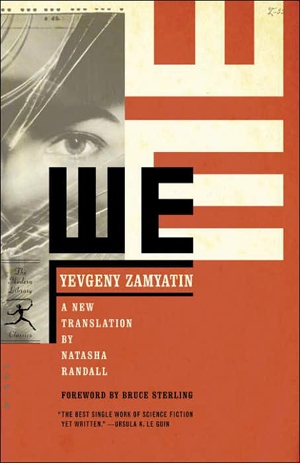
In this episode of the Libertarian Tradition podcast series, part of the Mises Institute’s online media library, Jeff Riggenbach makes the case that Yevgeny Zamyatin’s dystopian science fiction novel, We, belongs in the libertarian tradition.
You can also read the transcript below:
When we think of the libertarian tradition, we tend naturally to think of political philosophers and economists of the past. But surely one part of the libertarian tradition belongs to novelists and other fiction writers.
In earlier podcasts in this series, I’ve already discussed two such figures: Ayn Rand, whose 1957 novel, Atlas Shrugged, is, arguably, one of the half-dozen most important libertarian works of the 20th century, and John Ronald Reuel Tolkien, the professor of philology at Oxford whose giant fantasy novel, The Lord of the Rings, published just a few years before Atlas Shrugged, is arguably the most culturally influential single novel published in English in the 20th century.
This week, I’d like to talk about a writer whose level of influence has been much more modest, but whose indirect influence has nevertheless been considerable. Regular listeners to this series know what I mean by indirect influence. I gave an example of it just last week, when I discussed the life and career of Isabel Paterson. Paterson’s libertarian classic, The God of the Machine, has never reached a wide readership, but, thanks to the effort of her protégé, Ayn Rand, Paterson herself has influenced millions of readers who have never even seen a copy of The God of the Machine.
The writer I’m talking about today wrote a novel in which a citizen of a totalitarian state of the future meets a woman and becomes obsessed with her. He begins a forbidden sexual affair with this woman, meeting with her illicitly in a very old part of the city where the intrusive gaze of the all-encompassing government doesn’t seem to penetrate. Through his relationship with her, he becomes involved in the organized underground opposition to the all-encompassing government — an opposition he had never previously realized existed at all. Ultimately, he and the woman are caught, imprisoned, and tortured. In the end, he is sincerely repentant of his crimes and is completely devoted to the all-encompassing government that has done him all this harm.
A familiar story, no? Can you tell me what novel I’ve just described? Ah, I see a hand in the back of the room. Yes? “George Orwell’s 1984,” you cry out confidently. And your answer is correct, but only as far as it goes, which is, perhaps, not quite as far as you thought it would.
That is a description of the plot of 1984, which was published, as we all know, in 1949. But Orwell adapted the plot of 1984 from another novel, one originally published 25 years earlier in 1924. That earlier novel was entitled, simply, We. It was the work of a not-very-well-known Russian writer, Yevgeny Zamyatin. Zamyatin was not very well known outside Russia when We was first published, and he was still not very well known in the West 25 years later, when Orwell published 1984. He remains not very well known in the West to this day.
Help Promote Prometheus Unbound by Sharing this Post

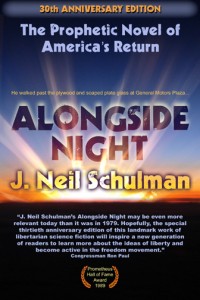
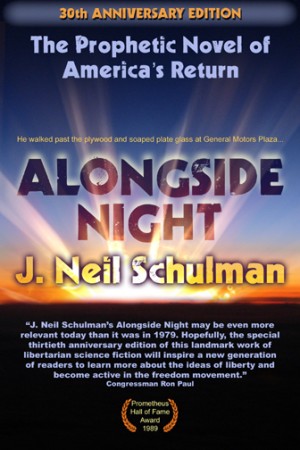
Alongside Night by J. Neil Schulman, so far as I am aware, is still the agorist novel par excellence. More than three decades have passed since its publication — not that you would know it without looking at the copyright date — yet in that time no other novel has so successfully mixed the principles of agorism with such a keen perspective on the future. There are not many novels that can top it for entertainment value either.
The story takes place in what was then the future, but which now seems a very prescient present. Not only is the story filled with theretofore unrealized gadgets and technology that differ from what we actually possess sometimes by no more than an appellation, or occasionally a small feature or manner of use, but the economic conditions described in the tale read like a seer’s forecast.
Schulman’s knowledge of economics allowed him to make a forecast every bit as accurate as the one for which Ayn Rand, in her novel Atlas Shrugged, has been lauded of late. In fact, this very knowledge of economics is probably what helped the author predict all those gadgets, for it is well established that science-fiction authors, a group not known for their economic acumen, tend to think on a grand scale when most of the advances, in a consumer-driven society, are modest devices of everyday convenience and entertainment.
It is a dystopian world we are plunged into in Alongside Night, where central control of the economy and erosion of civil liberties proceed, as they must, hand in hand. When the government abducts the protagonist’s father, a noted free-market libertarian economist somewhere between Milton Friedman and Ludwig von Mises in his radicalness, the high school student Elliot Vreeland embarks on a quest to free him. This quest takes him into the world of the agorists, free-market rebels and masters of counter-economics.
Help Promote Prometheus Unbound by Sharing this Post

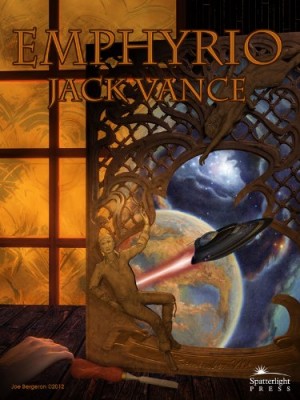
For the month of September we are reading and discussing Emphyrio by Jack Vance:
“The plot revolves around a young man, Ghyl Tarvoke, who hails from from the city of Ambroy located on the planet Halma. Halma’s ruled by unseen, mysterious Lords who run the planet as a giant welfare state. Workers are paid a stipend for their labor and all forms of mass production or duplication (including printing) are strictly, and I mean strictly, prohibited.” When Ghyl’s father, a wood-carver, is executed for processing old documents with a camera, Ghyl rebels and decides to bring down the system.
A recent edition of the book can be purchased for Kindle at Amazon.com. Your purchase via our affiliate links will help support our work here at Prometheus Unbound. If you prefer, Barnes & Noble has the book as an epub. There don’t appear to be any dead-tree editions in print, but new and used copies of old editions can be found.
Join us as we read and discuss Emphyrio. I’ve already started a thread on Vance’s idiosyncratic prose style.
You need not have voted on this month’s selection to join in the discussion, but you do need to be registered and logged in on this site to access the book club’s dedicated forums.
August Recap
Everyone enjoyed Matthew Alexander’s libertarian science fiction novel Wĭthûr Wē, both for its writing quality and for its uncompromising Austro-Libertarian content. The general consensus seems to be that Matthew did a very good job at the difficult task of incorporating the philosophical, political, and economic elements into the plot without coming across as too preachy. The novel rivals some epic fantasies in length, however, so it does take some courage to begin reading and perseverance to get through.
A couple of forum participants compared Wĭthûr Wē favorably to Ayn Rand’s Atlas Shrugged. One observed that Matthew presented the other side’s arguments more fairly. Another liked that, unlike Rand, Matthew illustrated how our ideals could be realized and that the main protagonist in Wĭthûr Wē is a more fully realized human being than Rand’s concretized ideals, such as John Galt.
Help Promote Prometheus Unbound by Sharing this Post

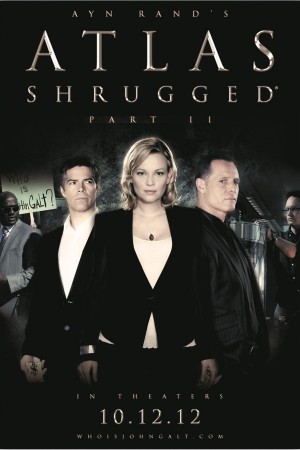
NEWS ROUNDUP | Fan Fiction vs. Copyright, Atlas Shrugged II Behind the Scenes, Polone vs. Hollywood
in Film, IP, News, Prose, Science Fiction
Reason.com has had some interesting posts recently.
One is on the subject of fan fiction vs. copyright. Does fan fiction count as a copyright violation? What should authors think or do about it? My response to the first question is: Who cares? Copyright is an illegitimate government grant of monopoly privilege that gives people legal ownership over that which cannot really be property, ideas, and which cannot be enforced without infringing on the prior real property rights (in one’s body and physical objects) of others. My response to the second question is: Authors should embrace fan fiction as community-building and free advertising. Fighting fan fiction only makes you a dick, a criminal (in my view) dick if you sue.
Anyway, now that I’ve worked that rant out of my system, check out the post Fan Fiction vs. Copyright – Q&A with Rebecca Tushnet and watch the interview below. Tushnet is “a member of the Organization for Transformative Works, Tushnet works to defend fan fiction creators caught in the legal debate between protected intellectual property and fair use.” I’ve previously discussed how Angry Robot Books is embracing fan fiction, if not as much as we libertarians and fiction fans would like.
Help Promote Prometheus Unbound by Sharing this Post


Author Archives

Support Prometheus Unbound



